Part 4 — Sam Harris — A Survivor's Story
Sam Harris
Listen to this chapter
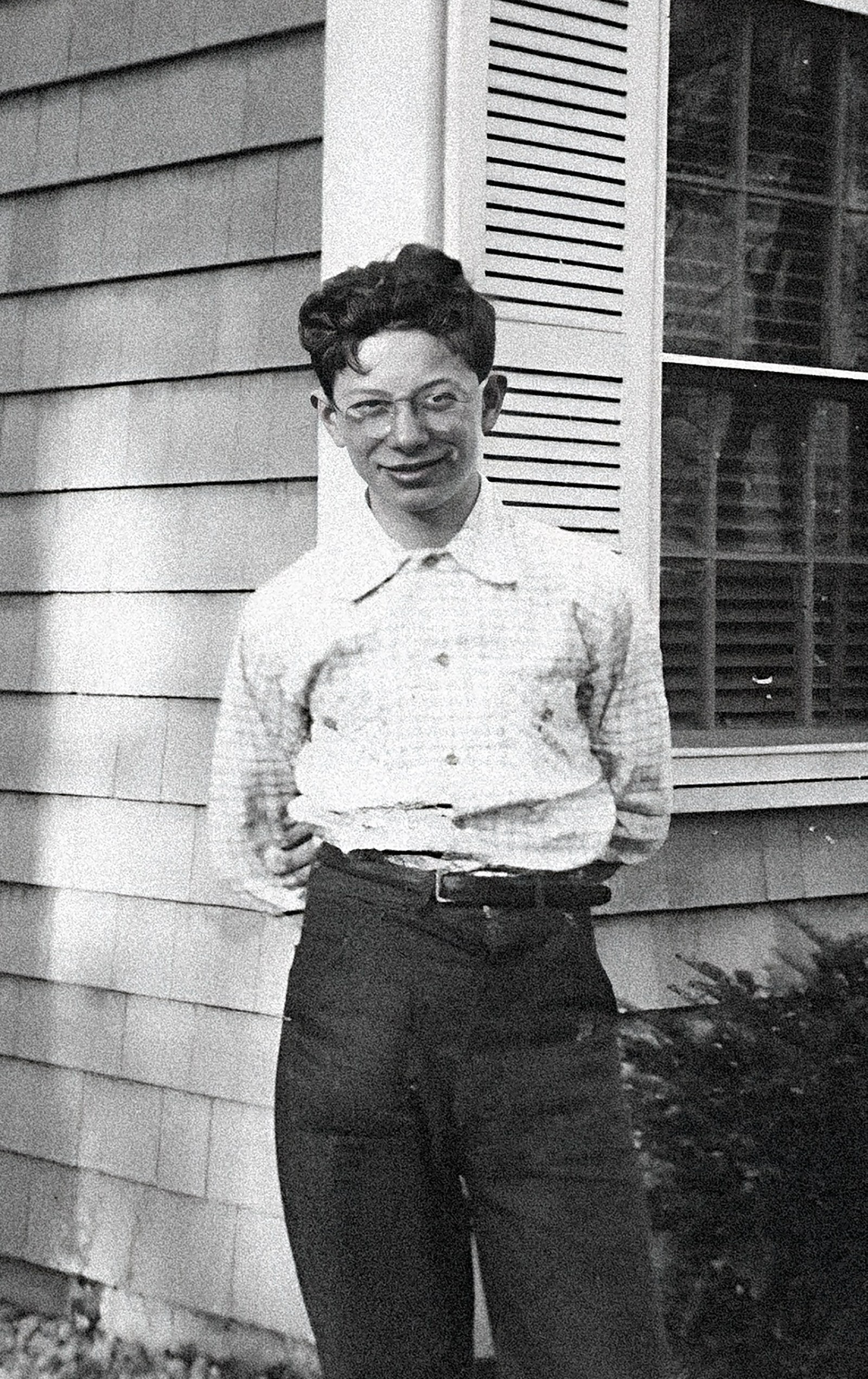
Sam Harris lost his childhood due to Holocaust. He ensures that a new generation of young people can thrive.
Sam Harris is passionate about this cause. Despite being 88 years old and using a walker, he will personally greet you at the somber, industrial entrance of the museum he helped create—an institution that ensures the horrific yet essential history he lived through will continue to be told, even long after he is gone, and his voice, one of the last direct eyewitness accounts, has fallen silent.
But this was not always the case.
For many years, Harris—a former insurance professional and a member of the Northbrook, Illinois Rotary Club—refused to speak about how the Nazis had taken him away as a little boy. He did not want to talk about the unbearable hunger, the fear, the machine guns, his murdered parents, the cattle cars, or the concentration camps. To him, it was an old story, a distant past. Why bring it up? He was an American now. First, an American boy growing up in Northbrook, a comfortable suburb north of Chicago. Then, an American man who could choose what he wanted to talk about—or what he preferred to keep to himself.
His silence lasted for many years. “I knew it weighed on him, that he was keeping it all inside,” says his wife, Dede, to whom he has been married for 62 years. “He just never talked about his past. I could see it boiling inside him.”
His reluctance was complicated. He did not want people to pity him. And if he was successful, he wanted it to be because of who he was, not because of what had happened to him. Sitting in a chair in the small but well-stocked library of his museum, he explains how, when someone noticed his accent and asked where he was from, he would turn the question back on them: “Where do you think I’m from?” If they answered “New York,” he would reply, “Yes, exactly! New York.” If they guessed “Germany,” he would say, “Germany, yes, how did you figure that out?” and smile.
His wife, Dede, a trained social worker, finally sat down with him one evening by a crackling fire. “I asked him to tell me his story,” she recalls. “It seemed to break through the barrier. Once he said it out loud, he was able to open up to others.”
It started slowly. In 1977, at a meeting of the Wilmette, Illinois Rotary Club, Harris met a fellow member, Rabbi William Frankel, who had grown up in Vienna. Like Harris, Frankel had fled from the Nazis, but he had turned his past into a platform for activism. He had marched with Reverend Martin Luther King Jr. during the U.S. civil rights movement in the 1960s and played a significant role in Catholic-Jewish reconciliation. He befriended Harris and convinced him that he owed it to future generations to share his story.
At the same time, some neo-Nazis were planning a demonstration in Skokie, a Chicago suburb with a large Jewish population, including many Holocaust survivors. Although a lengthy legal battle ultimately prevented the march, activists like Rabbi Frankel believed that silence and inaction were no longer options. Hoping that evil would simply fade away had never been a wise strategy.
Around that time, Arthur Butz, an associate professor of electrical engineering at Northwestern University in Evanston—just ten miles from Harris’s home—published a book claiming the Holocaust was a myth perpetuated by the Allies and Zionists. Frankel called Harris, outraged by the book. “Sam, I know this is hard for you, but it’s time for you to speak up,” Frankel urged.
In Frankel’s basement, the rabbi interviewed Harris on camera. “And that was the first time I was really able to speak,” Harris says. “I told myself: I will never do this again. But then he showed the video to everyone in the community. The room was full. Then he passed it on to other rabbis. It all happened because of Rotary.”
More than 30 years after the events, Harris finally began to talk about his once-unspeakable past.
“I asked him to tell me his story. It seemed to break through the barrier. Once he said it out loud, he was able to open up to others.”
As a living bridge from that lost pre-war Jewish world—through one of humanity’s darkest chapters and into the present—Harris is today a vibrant presence. Yes, he moves with a walker, but he also rolls into the lobby of the Illinois Holocaust Museum & Education Center in a fresh blue shirt, smiling and cracking jokes, his wife by his side. He passes by a display of Jewish faces—one of them his own. Many of those faces are no longer here. But he is.
“I did not tell you this to weaken you,” reads a line woven through the portraits, “but to strengthen you.”
The youngest of seven children, Harris was born in 1935 as Szlamek Rzeznik in Dęblin, Poland. His father was a sofer, a scribe who wrote and restored Torah scrolls and other sacred texts. At four years old, he was just old enough to remember the final moments of normalcy—Sabbath dinners, weekend visits to his grandparents by horse-drawn carriage. A last taste of a normal life, the sweetness of love and laughter, which helped him endure what was to come.
It was September 1939.
“I clearly remember sitting at lunch,” he says. “We heard noises in the sky. The German Luftwaffe flew in to destroy the Polish Air Force. Dęblin had an airfield. Soon, these planes also attacked the people. That was the first time I saw death.”
The Nazis quickly occupied Dęblin and forced Jewish families into a ghetto. Food became scarce. Harris’s older sister, Rosa, was forced to work at the airfield’s labor camp and brought back what little food she could for the family.
One day in 1942, trucks carrying Nazi soldiers entered the ghetto. Armed with rifles and bayonets, they drove the Jews onto the town’s marketplace.
“If someone refused or didn’t move fast enough, the soldiers stabbed or shot them,” Harris says.
Nearby, cattle cars waited to transport the Jews to an extermination camp. Harris believes their destination was the camp near the village of Treblinka in eastern Poland, where an estimated 700,000 to 900,000 Jews were murdered.
“I stood in line with my father, who held my hand,” says Harris. “Since I was so small, I could only see people’s legs and hear gunshots. All I could do was look up at the sky. I felt like a guardian angel was there to protect me.”
Harris’s father pushed the boy out of the line and ordered him to run. Fortunately, the Nazi soldiers didn’t notice, and he ran away. He saw his sister Sara hiding behind some bricks. The two children crouched and silently watched as their parents, cousins, brothers, sisters, and neighbors were taken toward the cattle cars. That was the last time Harris saw them.
Harris and Sara later reunited with their older sister Rosa. Constantly on the run, Rosa smuggled them into the forced labor camp. Harris was too young to work and would have been shot if discovered. His job was to hide.
Fate also played a role. Another prisoner, an Austrian Jew named Hermann Wenkart, recognized a Nazi soldier he had served with in the Austrian army during World War I. The soldier, Eduard Bromofsky, had been wounded in battle, and Wenkart had saved his life by carrying him to safety. Bromofsky introduced his savior to his SS comrades, who, impressed by Wenkart’s bravery, appointed him as the camp elder.
In 1944, as the Nazi troops retreated from the advancing Russians, they relocated Jewish forced laborers to a concentration camp near Częstochowa in southern Poland to produce ammunition for the front. Before leaving, Wenkart ensured that an officer signed a letter requesting that his daughter, Ruthi, and other arriving children be spared.
Meanwhile, Harris and his sisters arrived in Częstochowa, where a guard quickly tried to push Harris aside.
“My sister Rosa cried, and I didn’t want to leave,” he recalls. “Well, the guard kicked me right in my little chest.”
The guard grabbed Harris and took him to a room with four other children, all scheduled to be shot the next day. One of those children was Ruthi.
Wenkart made sure the letter was given to a Nazi officer in the camp. At first, the officer agreed only to spare Ruthi. Wenkart shook his head and insisted, “Either all or none.” The Nazi officer finally relented and let the children stay.
During the day, Harris lived in the shadows. He slept in a women’s barracks and constantly wet the bed out of fear of going to the latrine, where prisoners who had tried to escape were hanged.
“My bedding was a straw sack, and it started to rot,” he says. “I lay on it and got fleas and lice. They were everywhere, in my ears, and my whole body was pink.”
In January 1945, the Soviet army liberated the camp in Częstochowa. Harris was so hungry that when a fellow prisoner brought him a lump of butter from the kitchen, he ate the whole piece and got sick.
With rags for shoes, Harris hitchhiked with other survivors back to Dęblin, but their homes had been occupied by civilians. Harris and Sara were then placed in an orphanage after Rosa married a Jewish man from Vienna. In 1946, Rosa managed to smuggle Sam and Sara out of Poland to Austria and arranged for them to be adopted in the United States. After a stormy Atlantic crossing, they arrived in New York in 1947.
“The three words I learned on the ship were ‘yes,’ ‘no,’ and ‘Coca-Cola,’” Harris recalls.
What was America like for a boy who had grown up in a small Polish town and spent the last five years in one horrific camp after another? “I chewed gum,” he says. “We had white bread. I remember seeing Americans sitting with their feet on their desks, leaning back, eating steak. I thought that was pretty great.”
The two siblings were adopted by different families. “Nobody wanted two children from the concentration camps,” he notes.
He was adopted by the Harris family and moved to Northbrook, while Sara lived with a family in Chicago.
Growing up, he just wanted to “be an American boy.” He joined every club, became class president, and was popular among his peers, who had no idea what he had been through. “I had made up my mind to build a wall around my head, a concrete wall, and not talk about it.”
That was during the day when he could control his thoughts. But at night, disturbing dreams broke through that wall. “My adoptive mother would sit with me, crying, when I screamed,” he says.
Harris went to college and built a successful career in insurance. As his business grew, he joined Rotary in 1967. A cousin, a member of the first Rotary Club in Chicago, took him to a meeting. “I really liked it,” Harris says, “and I’ve been a Rotarian ever since.”
In 1978, NBC aired the miniseries Holocaust over four nights. More than 100 million Americans watched it, and it was credited with making the term “Holocaust” widely recognized. That same year, President Jimmy Carter established a commission that led to the creation of the United States Holocaust Memorial Museum in Washington, D.C. What would later become the Illinois Holocaust Museum also had its beginnings. Harris calls it “a little museum,” which opened in 1984 in a storefront in Skokie. Donations trickled in. In 2006, the Glencoe Public Library donated records from the Nuremberg Trials.
Harris wrote his story in a book, Sammy: Child Survivor of the Holocaust. But by the 1990s, he realized that a storefront—and even his book—would not be enough. But how do you build a museum? Where do you start?
Being an active Rotarian was key. “I was at a roundtable discussion with a group of Rotarians,” Harris says. “I said, ‘Hey, I volunteered last night to build a museum.’ Everyone wanted to be involved. One person said they would help me raise money. Another offered to find the land, and someone else would handle the architecture. My first committee was in Rotary. They all volunteered to work with me.”
As the museum neared completion, Harris emphasized the importance of making it more than just a memorial—it had to be a living part of the community.
“The purpose of the museum is to educate people,” Harris says. “As we move further away from World War II… gas chambers, killing all those people—people don’t know about it anymore.”
A recent survey of Americans under 40 found that 12 percent had never heard the word “Holocaust.” Nearly half couldn’t name a concentration camp, and 63 percent didn’t know how many Jews were murdered.
In the late 1980s, Harris joined a successful campaign that required Illinois public schools to teach Holocaust history.
Harris’s cracked leather belt is displayed in the museum. “This belt is the only thing I have left from the concentration camps,” he says.
The museum opened in 2009 in a stark gray and white building designed by renowned architect Stanley Tigerman, symbolizing a journey from darkness to light.
Harris remains deeply involved in youth outreach through Rotary. “I don’t want this brutal tragedy to happen to other children just because of their race,” he says.
International Holocaust Remembrance Day is January 27, the anniversary of the liberation of Auschwitz-Birkenau.